|

KUNG
FU is a Chinese word meaning, skill derived through time and effort. In proper Chinese, it is pronounced, “Gong Fu”. Today, Kung Fu is commonly used to replace the word “Wushu”, which is the actual translation for Martial Art. Many styles of martial arts exist in China, some as young as 100 years and others as old as 500. As opposed to solely a healthful practice, a sport, a self defense or military hand to hand system, Chinese Kungfu always has three aspects, the cultural, the healthful and the self-defense. Sometimes, certain schools emphasized one aspect over the others but typically all three were included. These styles with lineage, tradition, emphasis on self-defense and health, are known as “Traditional” Styles.
In the last few decades, the People's Republic of China recompiled and promoted a “Contemporary” version formalizing and systematizing the study of Wushu. This Contemporary version breaks its links with lineage and tradition and is practiced as a demonstration sport, much like gymnastics, judged and given points according to specific rules. Within China, this distinction is easily made with the use of Traditional or Contemporary before the word Wushu. Outside of China, particularly in English speaking countries, Wushu is often used to refer to the Contemporary version, while Kung Fu is used to refer to the Traditional Arts.
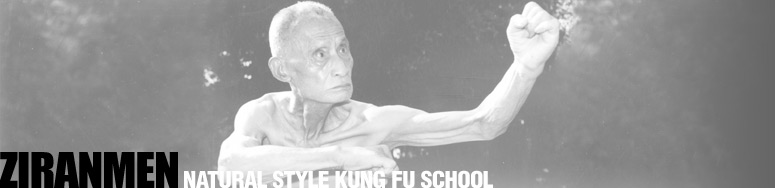
NATURAL STYLE KUNGFU or ZIRANMEN, is a rare and unique traditional martial art that includes methods of flexibility, hand forms, weapons, self-defense, and body conditioning. It calls for the use of the entire body in an integrated way to exercise and progressively strengthen the muscles, tendons, ligaments and bones. It has similarities to both Shaolin and Wudang meaning it has the strong points of the so called external and internal styles, so the body is controlled in a way that is both powerful and graceful, fast and slow, hard and soft. Classes teach confidence, patience, and discipline while improving your grace, strength, agility, and self defense skills.
GRAND
MASTER WAN LAISHENG'S SCHOOL CURRICULUM INTRODUCTION
There
are many different styles in Chinese martial arts–internal
and external; southern and northern; broad and straight sword,
spear and staff; long and short fist–each with its own
merits. To practice martial arts is, in fact, to practice the
coordinated movements with one’s hands, eyes, shoulders,
elbows, wrists, thighs and knees-thus Kung-fu! Through the
use of “Jing-Qi-Shen” (essence-energy-spirit,
some would say body-mind-spirit) as the foundation, and hands,
eyes and body as the root to nourish “Qi” to a pure
and natural energetic force, one will not be easily stirred by
external influences and will be able to use one’s gongfu
to face and conquer his opponent.
Ziranmen
emphasizes three styles of gongfu–soft,
hard and light. It teaches three character traits–wisdom,
benevolence and courage, and four virtues–trustworthiness,
righteousness, chivalry and bravery. Ziranmen, as indicated by its
name, calls attention to a natural state during practice. As in learning
any skills, in the beginning one will feel very unnatural (which
is but a necessary precursor) before one can attain naturalness.
Without following the rules coupled with hard work, how can one achieve
that day of natural fulfillment which is Ziranmen Kungfu? With
time spent practicing the set forms and adherence to the principles,
over time one shall attain this natural state.
In
addition to defense and conditioning, martial arts also helps one
get rid of bad habits and can increase one’s energy and
spirit. It can offer ten times the benefits of any other hobby. It
promotes people’s mental and physical health, and enhances
friendship through joint efforts in international research and friendly
competitions. Essentially, martial arts is a practical study for
self-enhancement and the foundation for nurturing a strong will.
Chinese
martial arts are profound, the more one learns the deeper one finds
it. When one can reach the point where “essence” is
developed in the bones and “qi” in marrow, long-life
and long-lasting vision will result. Martial arts does not only help
one build a healthy body, it also helps build a dignified personality
and a joyous charitable spirit. As learning progresses, boundless
energy and hand and eye dexterity will be attained, and one’s
character will become flexible and honest. To this end, one can easily
achieve goals of helping others, benefiting oneself, and living in
harmony with all. In a word–different.
Grand
Master Wan Laisheng
August 1, 1988
Fuzhou City, China

|